|
Wood / Central Cadillac Property - Gold
Cadillac Township, Quebec (NTS 32D/01)
Updated July 2019
Property Description and Location
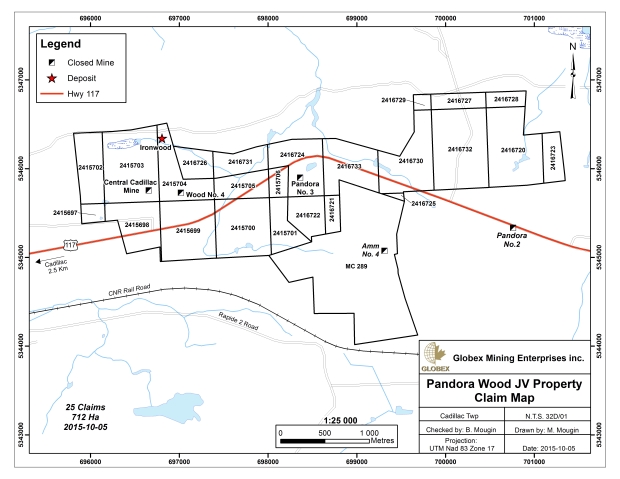
The property consists of 24 claims and one mining concession totaling 712 ha straddling Trans-Canada Highway 117 and positioned midway between the mining cities of Rouyn-Noranda, 50 km to the west and Val d’Or, 50 km to the east. Ownership is shared equally between JV partners Globex (50%) and Canadian Malartic Corporation (50%). Eight of the 24 claims located in the west central portion of the property (the Wood Claims) are subject to an underlying 2% NSR to five individuals. 18 claims and one mining concession are subject to an underlying 0.5% NSR to Barrick Gold Corporation. 2 mining claims are subject to an underlying 1.5% NSR to Globex. All mining claims have now been transformed into 24 cells and 1 mining concession by the government of Quebec.
Globex is the operator of the Joint Venture.
History
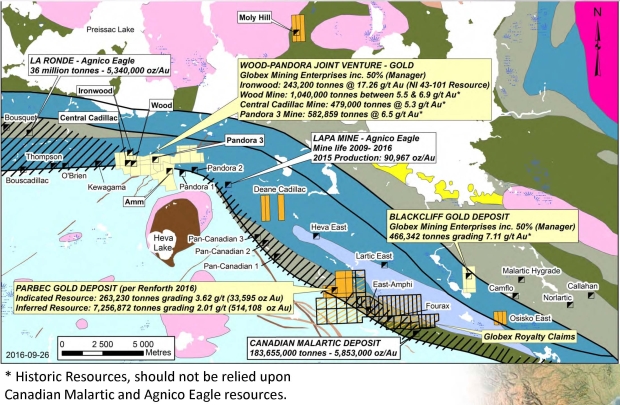
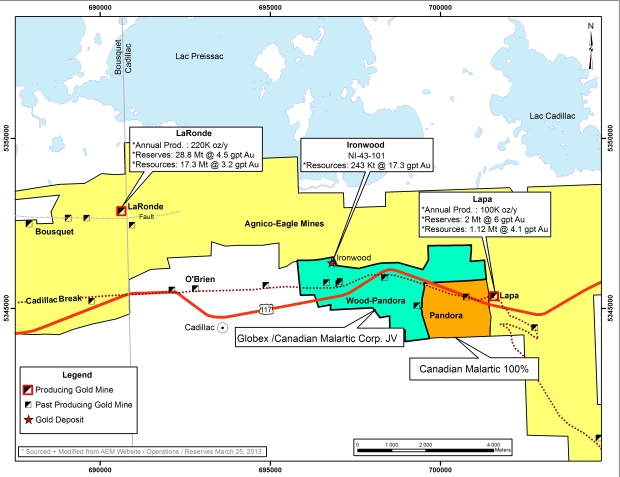
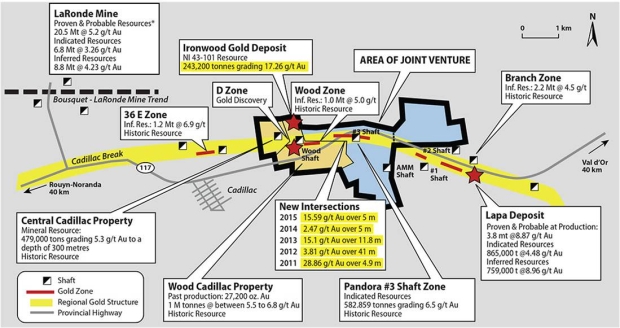
The property is situated in the heart of Quebec’s premier gold producing district, the Cadillac Gold Camp. Specifically, the property is centered over the prolific Cadillac Break and is located 3.5 km west and along strike from Agnico Eagle’s producing Lapa Gold Mine (prov./prob. reserves of 170,000 oz at 5.84 gpt Au). It is also located 7 km east of Agnico Eagle’s La Ronde Gold Mine (prov./prob. reserves of 3.43 M oz at 5.2 gpt Au (ref. Agnico Eagle press release, February 11, 2015 - Gold Reserves by Mine, as at December 31, 2014). La Ronde is Canada’s deepest U/G gold producer, is developed along another major east trending mineralized gold structure located 2 km north and parallel to the Cadillac Break.
The property has been well explored and drilled above a vertical depth of 200 m along most of its strike length and has seen gold production on near surface deposits since mining commenced in the region in 1937. Gold was mined at several localities including:
-
the Amm Shaft Zone (shaft to 140 m: production reported at 14,490 oz from 83,475 t grading 5.4 gpt Au (ref. M.E.R.N., report MB88-25, 1989);
-
the No.3 Shaft Zone (shaft to 267 m: production reported at 13,680 oz. from 83,418 t grading 5.1 gpt Au: (ref. M.E.R.N. report, 1981 on behalf of Camflo Mines) and where an historic mineral resource of 582,859 t grading 6.5 gpt Au is located (ref. Queenston Mining, internal report, 1981).
-
The Wood-Cadillac and Central Cadillac Zones. (Wood-Cadillac shaft and internal winze to 305 m) saw the production of 59,689 oz. from 396,000 t of material grading 4.8 gpt Au (ref. J. Daigneault & M. Sirois, M.E.R.N. report, 1981). The Central Cadillac shaft (depth of 305 m) saw the production of 63,160 oz. from 418,870 t of material grading 4.7 gpt Au (ref. J. Daigneault & M. Sirois, M.E.R.N. report, 1981) and where an historic resource of 249,000 oz gold from 1.43 Mt of material grading 5.3 gpt Au is reported.
The Queenston No. 3 zone and Central Cadillac resources are historic mineral resources which were estimated prior to the implementation of NI 43-101. These resources were not prepared by a Qualified Person under the instrument and cannot be relied upon.
Geology and Mineralization
The northern half of the Pandora-Wood property is underlain by steeply south dipping greywackes, mudstones and banded iron formation of the Cadillac Group. The southern portion of the property is underlain by greywackes and lesser mudstones of the Pontiac Group. The sedimentary groups are separated by a narrow but critically important 50-200 m wide band of talc/chlorite schists (altered & sheared ultramafic flows) and mafic volcanic rocks of the Piche Group that strike east-west and dip steeply to the south. The Cadillac Break is best developed within the Piche Group mafic and ultramafic volcanic but occasionally widens to encompass parts of the adjacent bounding sedimentary formations.
Most of the gold mineralization in the Camp is closely associated with the Cadillac Deformation Zone and its subsidiary structures. The deposits are quartz-lode type, generally consisting of auriferous sulphide-bearing quartz-carbonate shear veins frequently containing free milling gold, disseminated pyrite haloes to the veins in shear zones and related structures and to a lesser extent, veins in extensional fractures, structural zones, and breccias.
Amm Shaft Zone. Mineralization consists of quartz-arsenopyrite, with minor pyrite mineralization occurring as lenses and stringers localized along shear zones in fractured greywacke and altered porphyry. In 1994, Santa Fe Mining completed four deep holes to an average vertical depth of 430 m. Three of the holes intersected broad zones of low grade gold mineralization in biotitic sediments and porphyry dikes which averaged 0.3 - 2 gpt Au over core lengths of 50 to 80 m including higher grade intervals assaying 3.4- 9.6 gpt over 2.0 – 3.1 m. In 1999, Queenston intersected the Amm mineralization in a deep hole assaying 1.0 gpt over 25.4 m including 7.4 gpt over 1.7 m.
No. 3 Shaft Zone. Most of the gold mineralization outlined at this location occurs in the Cadillac greywacke units bounded by an iron formation to the north and the sheared ultramafic units of the Piche group (talc/chlorite schists: “the Cadillac Shear”) to the south. The mineralization consists of free gold in quartz, with associated gold bearing arsenopyrite, minor amounts of other sulphides, tourmaline and scheelite. Near the iron formations coarse free gold occurs with ‘sedimentary’ banded graphitic pyrite. Quartz veining is commonly controlled by vertical shear structures and subsidiary discontinuous horizontal tension fractures. The vertical structures consist of braided fractures and shears containing irregular veins, stringers and patches of quartz.
In 1979, Camflo Mines outlined an historic resource of 582,859 tonnes grading 6.5 gpt (Queenston Mining, internal report, 1981) based on a shallow drill program in the vicinity of the No 3 Shaft. In 1981, their exploration efforts continued underground with 1,374 m of drifting, 107 m of raising, and 86 underground diamond drill holes. However, the results of the underground program were not deemed sufficiently encouraging to pursue further work.
Wood-Cadillac and Central Cadillac Zones. The Wood-Cadillac shaft and internal winze were sunk to 305 m with 6 levels and production in two stages between 1937-42 and 1947-49 amounting to 59,689 oz. from 396,000 t grading 4.8 gpt (J.Daigneault & M. Sirois, M.E.R.N. report, 1981). The Central Cadillac shaft was sunk in 1937 to a depth of 305 m with 6 levels and production between 1939-43 and 1947-49 amounted to 63,160 oz. from 418,870 t grading 4.7 gpt (J. Daigneault & M. Sirois, M.E.R.N. report, 1981). The Wood and Central Cadillac properties were jointly operated during the 1947-49 period.
Gold mineralization at Wood and Central Cadillac occurs in three forms:
-
Narrow shallow dipping quartz-tourmaline-sulphide-scheelite-native gold vein flats, 2-20 cm in thickness that occur as stacked sets adjacent to the Cadillac Break largely in Piche volcanics.
-
Lenticular sulphide zones, 0.1-1.5 m thick consisting of 1-30% pyrite and sub vertical quartz veining developed at the margins of four iron formations.
-
Biotitic silicified zones with 1-20% disseminated sulphides including arsenopyrite and locally up to 10% tourmaline.
At Wood-Cadillac an inferred mineral resource was reported by H. J. Bergman, P. Eng. in 1974 and at Central Cadillac, A.C.A. Howe International Ltd. calculated an inferred resource in 1988. Both the Wood and Central Cadillac resources were calculated prior to National Policy 43-101 Standards of Disclosure for Mineral Projects, are historic in nature and should not be relied upon, as the accuracy has not been verified by a Qualified Person.
Mineral Resources
Current Inferred Mineral Resources. Ironwood Project
In 2006, drilling of the weak airborne electromagnetic anomaly resulted in the discovery of what is now known as the Ironwood gold deposit. The majority of 35 holes totalling 8,313 m have outlined a gold bearing sulphide zone within a regional magnetite iron formation. A zone has been outlined to date over a strike length of 75 m and to a depth of 250 m. Drill hole intersections up to 11.6 m grading 22.2 g/t au have been intersected.
In 2007, Globex drilled an additional five holes totalling 2,400 m on the Ironwood Gold Zone and nine holes totalling 3,500 m on the Central Cadillac property. The Ironwood drill holes helped to better define the limits of the gold mineralization while the Central Cadillac drilling tested the depth potential of certain areas of the property intersecting narrow gold zones. Detailed geophysical surveys have also been undertaken on the property, including Induced Polarization, magnetometer and electromagnetic surveys.
In early 2008, a NI 43-101 Technical Report was completed on the Ironwood zone on behalf of the Globex/ Queenston JV and a new inferred mineral resource was calculated on the deposit by Qualified Person, Reno Pressacco, M.Sc., P. Geo.
Pressacco describes mineralization at Ironwood as follows;
“The gold mineralization discovered at the Ironwood deposit is hosted by an oxide iron formation (magnetite and hematite dominated) and consists primarily of replacement of the host oxide iron minerals by an assemblage of pyrrhotite-arsenopyrite-pyrite. Gold mineralization has been traced along a strike length of approximately 90 metres, from depths of 30 to 230 metres below surface, and can reach thicknesses of up to 10 metres. While the limits of the mineralization appear to have been defined at depth, the limit of the mineralization has not been defined by drilling along the western strike extension. The mineralized zone has a general strike of approximately azimuth 080° and dips vertically to steeply south. This orientation is interpreted to occur as a slightly discordant orientation to the strike of the host stratigraphy.
A direct correlation is observed between the amount of secondary sulphide minerals (pyrrhotite-arsenopyrite-pyrite) and gold grades. Quartz veining is observed, however it is typically composed of a massive, white to milky coloured quartz that exhibits a negative correlation with gold grades (Figure 9.3). A pyrite-calcite alteration phase has also been observed. While the pyrite content correlates well with gold grades, the calcite veins are dilutive with respect to gold grade. The overall main sulphide assemblage (po – asp +/- py) consists of disseminated, patchy and semi-massive sections that exhibits good replacement textures and overprint the host magnetite iron formation. The size of the sulphide grains and patches ranges from submillimeter to 1 centimetre or more.”
Ironwood Project – Inferred Resource Estimate
|
|
Tonnes
|
Grade (gpt)
|
Ounces
|
|
Ironwood Deposit
|
243,200
|
17.3
|
136,000
|
2010 to 2014 JV Exploration Programs
In 2010, the JV completed twelve (12) holes totaling 4,450 m targeting the “South Break” or “South Contact” as well as the “North Break” (structurally and stratigraphically equivalent to the “Contact Zone” described at the Lapa Mine, 5 km to the east along the Cadillac Break. The work examined a one km strike length of the mineralized structure extending 800 m east and 200 m west of the Pandora #3 Shaft in the central portion of the property. Best drill intercepts included: 10.81 gpt Au/3.7 m (hole W10-81), 3.08 gpt Au/8.4 m (hole W10-85), 4.32 gpt Au/4.3 m (hole W10-87), 14.71 gpt Au/2.9 m (hole W10-82), 12.99 gpt Au/1.3 m ( hole W10-83), 13.96 gpt Au/3.0 m and 7.71 gpt Au/3.8 m (hole W10-84).
In 2011, the JV completed five (5) holes totaling 2,405 m. Four of the holes were positioned to follow up on results from the 2010 campaign in the area of the #3 Shaft Zone. Holes W11-89 to 11-92 all intersected gold values within or adjacent to the Cadillac Break. One of the deeper holes of the program, W11-92, intersected an exceptional 28.86 gpt Au/4.9 m at a vertical depth of approximately 350 m. Other important intercepts include; 8.2 gpt Au/1.0 m (hole W11-89); 4.5 gpt Au/1.5 m; 3.88 gpt Au/6.5m (hole W11-91); 3.6 gpt Au/2.8 m and 6.6 gpt Au/1.0 m (hole W11-92). A fifth drill hole, W11-88, targeted an interpreted structural feature near the Amm Shaft on the southern portion of the Joint Venture property. This hole did not return any significant gold mineralization.
In 2012 the JV completed nine (9) drill holes totaling 5,600 m. The program focused on searching (along approximately 100 m centres at depths of 350 to 450 m) for significant lateral and down plunge extensions of the deep Pandora #3 zone gold mineralization located in 2011 (W11-92, 7.5 gpt Au/21.5 m).
Significant gold intercepts from this program included; 7.99 gpt Au/2.0 m, 7.14 gpt Au/2.0 m (hole W12-93); 11.73 gpt Au/1.3 m (hole W12-95); 4.09 gpt Au/4.5 m (hole W12-96); 22.08 gpt Au/1.0 m (hole W12-97); 3.8 gpt Au/41.0 m including 4.77 gpt Au/8.4 m and 12.6 gpt Au/9.1 m (hole W12-99B); and 3.05 gpt Au/4.0 m (hole W12-100).
Globex welcomed its new JV partner, Osisko Mining Corporation (‘Osisko’), on December 28th ,2012, when Osisko announced the successful completion of a plan of arrangement between Queenston and Osisko whereby Osisko had acquired all of the issued and outstanding common shares of Queenston. Globex continued as project operator.
In 2013, the JV completed a total of 20 drill holes totaling 11,770 m of drilling, concentrated in the centrally located Pandora #3 shaft area and at the Central Cadillac area in the western portion of the property. A single drill hole was also completed in the AMM Shaft area, south of the main Cadillac Break. Drill spacing ranged from 50 to 150 m with vertical depth of investigation averaging 300 m in the Central Cadillac area and 400 m in the Pandora # 3 area. The best gold intercepts are found within in moderately to strongly altered biotite/silica rock hosting weakly pyrite/ arsenopyrite/pyrrhotite (+/-) mineralized quartz/carbonate veins or veinlets. This mineralization often contains free gold and is best developed in the Cadillac Group sediments adjacent to ultramafic volcanics at or near the “North Break” a major lithological contact. Best gold intercepts for the program included:
-
Pandora #3 Area: 6.4 gpt Au/4.27 m (hole W12-101); 158.5 gpt Au/0.65 m (hole W13-106), 15.1 gpt Au/11.80 m including 47.8 gpt Au/3.30 m and 5.0 gpt Au/4.0 m (hole W13-107).
-
Central Cadillac Area: 3.8 gpt Au/7.56 m (hole CC13-001); 3.8 gpt Au/9.80 m (hole CC13-004); 4.8 gpt Au/ 10.65 m (hole CC13-006).
-
AMM Shaft area: 2.2 gpt Au/6.90 m (hole AMM13-01).
The 2013 drill results continue to indicate excellent discovery potential for outlining a significant high-grade mineral resource at a depth below 400 m in the area of the Pandora-Wood No. 3 Shaft Zone as well as in the less deeply explored Central Cadillac sector.
In 2014 a four-hole drill program totaling 2,637 m was completed in April. This program targeted possible extensions of some of the better 2012 and 2013 drill campaign gold intersections near the Pandora #3 shaft. One additional hole (W14-113) was drilled in September at the Amm claim. The high-grade gold intersections from the 2012-2013 programs were not repeated (not uncommon with free gold deposits), but the mineralized structures identified in previous drilling were intersected showing continuity at depth. Highlights from the 2014 drilling at Pandora-Wood included; 5.1 gpt Au/1.0 m (hole W14-109); 1.07 gpt Au/7.6 m (hole W14-110); 4.88 gpt Au/1.0 m and 2.47 gpt Au/5.0 m (hole W14-111); 2.97 gpt Au/2.0 m (hole W14-112B); and 6.08 gpt Au/1.5 m (hole W14-113).
During the first quarter of 2014, Osisko accepted a takeover offer from Yamana Gold Inc. and Agnico Eagle Mines Limited. In the second quarter, the takeover was completed and Globex welcomed the Canadian Malartic Partnership as Globex's new partner at Pandora Wood.
During the eleven-year period of the Pandora-Wood JV, over fifty significant gold intercepts have been identified primarily in the Pandora #3 sector of the Cadillac Break. The exploration model used is that of Agnico Eagle’s deep seated Lapa Gold Mine which operates on the Joint Venture’s eastern property boundary (Prov. & prob. reserves of 170,000 ozs grading 5.84 gpt Au: (ref. Agnico Eagle press release, February 11, 2015 - Gold Reserves by Mine, as at December 31, 2014). The top of the sub vertical dipping Lapa gold deposit is located at a vertical depth of approximately 450 m below surface and the deposit extends vertically for at least 1,500 m and remains open to depth. Of importance is the recognition that the minable ore at Lapa is developed nearly 200 m directly below the shallow Tonawanda Zone gold mineralization, which extends from subsurface to a depth of approximately 300 m. Specifically, the published structural, stratigraphic and metallogenic features described in M. Simard’s Ph.D. study (UQAC, 2011) of the Lapa deposit allow for a compelling direct analogy between many of the features of gold mineralization at the Lapa Gold Mine and at the JV’s Pandora # 3 sector. In both settings, the auriferous smoky quartz vein systems with the commonly associated strong biotite/silica alteration and finely disseminated arsenopyrite/pyrite, whether developed within the Cadillac sediments or nearby sheared Piché Group ultramafic volcanics, serve as reliable metallotects for significant gold mineralization.
In 2015, two phases of drilling were completed. A three-hole Phase 1 drill program totaling 1,802 m was conducted in early April. Drill hole CC-15-10 returned 4.22 gpt Au/2.25 m from 256.85 to 259.10 m and 3.11 gpt Au/3.0 m from 510.5 to 513.5 m. Drill hole W-15-114 intersected two mineralized zones of 30 cm and 90 cm length but returned no significant values. Drill hole W-15-115 returned 12.3 gpt Au/2.0 m from 633.0 to 635.0 m and 2.17 gpt Au/3.0 m from 652.0 to 655.0 m. Phase 2 consisted of a three-hole drill program totaling 1,638 m and was completed in September. The first hole, W15-116B returned an average of 15.6 gpt Au/5.0 m including an interval of 24.4 gpt Au/3.0 m. Drill hole W15-117 intersected a NE-SW major fault which displaced the host lithologies and the mineralized zones where not encountered. Drill hole W15-118 returned 3.30 gpt Au/3.0 m and 2.29 gpt Au/3.35 m.
|